

Homestays needed for international scholars

Photo of Society for Conservation GIS scholars with their homestay host family.
If you have some space in your home between June 14 and July 7 (or even a part of that time), and you enjoy getting to know people from around the world, please consider helping host one or two of the Society for Conservation GIS scholars (SCGIS)!
This summer between 17 and 25 young adult international visitors will be coming to Davis to attend specialized GIS training provided by the Society for Conservation GIS (SCGIS). These international scholars (usually between the ages of 22 and 40) were selected from a global pool of applicants. They will be in the US for about five weeks, and for three of those weeks they will need housing in Davis. This will be the fourth summer that the Davis community has hosted the SCGIS scholars.
Scholars will be in class at UC Davis (in a computer lab) 8-10 hours per day, sometimes including Saturdays, and will often eat meals together after class. SCGIS will provide them with funds to cover the cost of their food, but because of a limited budget, SCGIS cannot afford hotels. After leaving Davis, the scholars will be attending the Esri International User Conference in San Diego (July 8-12) and then the Society for Conservation GIS annual conference in Monterey (July 14-18). Most will then head home.
This is a fantastic opportunity for cultural exchange. Lifetime friendships often develop between host families and scholars, and these often include invitations for host family members to visit and stay with the scholars in their home countries. The countries represented by scholars this year (tentatively) include: Uruguay, Laos, DR Congo, Nigeria, Brazil, China, Mexico, Armenia, Philippines, Slovenia, Bulgaria, Cameroon, Argentina, Zambia, Japan, South Africa, and Indonesia. There are also at least four advanced scholars who may be coming from one or more of these countries: Russia, Cameroon, Brazil, Colombia, Uruguay, Madagascar, China, Argentina, and Canada.
It is best if scholars can stay in a guest room (1 or 2 scholars per room), but even a sofa bed in the living room can work if that’s what you have. Your commitment beyond a place to stay is minimal, but there will be opportunities to join the scholars for some meals and parties throughout their stay.
If this sounds interesting to you, please contact Steve Blum (email: sb17@aol.com or phone: 916.715.4597) or Karen Beardsley (kbeardsley@ucdavis.edu). They will be happy to discuss this in more detail, so please let them know if you have any questions! Also feel free to pass this along to others you know who may be interested.
Downtown Davis Parkway Greening Project: Community Meeting Recap
Didn’t get a chance to attend the community meeting about the Downtown Davis Parkway Greening Project? Interested in how it all played out?
On Saturday, March 2rd thirty-four community members and stakeholders met to tour the project and discuss the new design. Participants broke into two groups and toured the future California Native Plant Garden (located between the east end of the Arboretum and the Davis Commons parking lot) and a portion of Putah Creek Parkway (which goes under the railroad tracks and connects north and south Davis). The group then gathered to provide feedback on the proposal. And, as often happens here in Davis, a lively discussion ensued! Both pedestrian and cyclist interests were well represented, as were concerns about circulation connections, long term maintenance of the site, project signage, wildlife diversity, and ongoing community involvement. Overall, participants were excited about the proposed improvements and eager for the process to get underway.
For those of you who were able to make it to the meeting, thanks for your feedback! It’s an invaluable part of the design process and a resource that we will continually return to as we finalize the construction documents.
Look for construction of the California Native Plant Garden to begin this summer!
Notes and exhibits from the meeting:
Site plan with notes from workshop
Summary of workshop comments
To read more about this project, CLICK HERE.
“An ‘Eyeconic’ Weekend,” a free celebration of roses for the public
“An ‘Eyeconic’ Weekend” a free Celebration of Roses for the public will be taking place at UC Davis May 4 and 5th, 2013. Sponsored by the California Center for Urban Horticulture, Foundation Plant Services and their partners and sponsors this free, two-day Rose Extravaganza will have workshops, tours and a plant sale of fantastic plants. From 11:00 to 4:00 pm demonstrations will highlight methods for growing beautiful roses successfully featuring new rose varieties, best pruning practices, proper plant placement, planting techniques, pest management and disease identification of these hardy and colorful flowering shrubs. In the afternoon, tours of the brilliant colors of the eight acres of rose fields and more than 400 rose cultivars are sure to be a magnificent sight. At the Rose Sale from 10:00am to 4:00pm choose from thirty-two varieties of both classic and novel roses to find the one perfect to add to your home landscape. Free mini-floribunda roses will be given to the first 250 attendees on both days!
Roses available will include hybrid teas such as the tough Carefree Wonder that needs little pruning and yet blooms prolifically from spring to fall. Or perhaps select one of the new floribunda Eyeconic Series or the hybrid Hulthemia roses developed by hybridizing with the species Hulthemia persica to produce a new disease resistant bloomer with a characteristic red blotch at the base of the petals. Eyeconic varieties also will be available in yellow, darker pink and melon colors.

Photo of Rosa Tiddly Winks courtesy of Weeks Roses.
If fragrance is what you seek consider Baronne de Rothschild a fuschia-pink rose with strong fragrance and beautiful large flowers. Or perhaps Bolero a large, pale pink to white flower with a marvelous rose scent mixed with tropical fruit, great for cutting. Need a climbing rose to cover an arbor? Try the large fire engine red flowers of ‘Winner’s Circle’. Or short on space? Tiddly Winks is a miniature rose that can be one of the work horses in your small garden. Tidy and compact it has an orange-pink interior with a yellow eye sure to brighten that container garden or border over the long season.
We hope you will come and attend this great day and help us celebrate the beauty and fragrance of roses. The event is from 10:00 am to 4:00 pm at Foundation Plant Services (FPS), 455 Hopkins Road.
For directions, list of roses and the day’s agenda VISIT THE WEBSITE for the California Center of Urban Horticulture.
Jack Dangermond, president and founder of Esri, shares vision and launches pilot project with Arboretum and Public Garden
(Readers: please note that this article was used as a promotional piece/press release and refers to a talk that has already taken place.)
Remember when you used to need 10 cents to make a phone call outside your home? The nostalgia of questions like this and others is no longer reserved for older generations. The advent of digital books and music, smart phones, and social media have opened our world to whole new professions, networks of communication, ease of access to media and information that were unheard of just 5 years ago. What technology will change our lives next? Jack Dangermond, president and founder of Esri, one of the world’s foremost geographic information system companies, is going to let us know.
In an extraordinary talk—arranged in partnership with the College of Agricultural and Environmental Science’s (CAES) Agriculture Sustainability Institute (ASI) and Information Center for the Environment (ICE), and as part of the Arboretum and Public Garden’s commitment to inviting thought leaders to campus—the UC Davis community of students, faculty, researchers and staff are invited to take a guided tour of a new ecosystem of tools available to GIS (Geographic Information System) users Friday, April 26 from 3-4:30 pm in the Activities and Recreation Center (ARC) Ballroom.
Dangermond’s talk titled, “GIS as a Platform: What it Means for GIS Users,” will inform the audience of recent and transformative changes to GIS technology. Not familiar with GIS? Think you are not a GIS user? Don’t allow yourself to be thrown off by a technical abbreviation. Once the domain of highly trained technical experts, GIS tools, as well as the once difficult to locate data necessary to explore interesting and important questions, are now available anytime, anywhere, and to anyone. If you’ve used a mapping program via the internet, used a smart phone to access location-aware content, or tracked a Fed Ex package…you are a GIS user. GIS is a tool that integrates hard data like a location or an address, with new ways to manipulate that data so it tells a story. Your story might be how you get from point A to point B, or, your story may be infinitely more complicated, like communicating the effects of climate change.
If you’ve got a story to tell and you understand the power of location in telling that story, then this talk is for you. You will leave this engagement with ideas for communicating to your audience in ways you did not think were possible without a team of technical experts and data entry specialists, and that is just the beginning.
Date: Friday, April 26, 2013
Time: 3-4:30 pm
Place: UC Davis ARC Ballrooms MAP
Admission: FREE
RSVP: Carrie Cloud at crcloud@ucdavis.edu
Visit to serve as launch of Esri-UC Davis pilot project
Dangermond’s UC Davis visit will also serve as the launch of a ground-breaking Esri-UC Davis pilot project. Dangermond’s passion for supporting conservation science combined with the Arboretum’s leadership and wide-reaching effort to bring GIS tools and education to public gardens, parks and zoos worldwide, has led to Esri selecting UC Davis and its Arboretum and Public Garden as the site to build a suite of cloud-based mobile GIS tools to manage their organization and campus collections. The new tools that result from this work will be shared with botanical gardens and zoos around the world, to help them understand and protect the earth’s biodiversity as well as educate their 50 million visitors about critical issues in conservation science.
“Over the past 10-years, the UC Davis Arboretum’s curatorial team has secured over $850,000 from a variety of federal grants and donations—not only to map and manage our own collections—this funding has enabled our team to become a leader worldwide for educating other public gardens about the advantages of adopting and integrating this technology into their work flows,” cites Kathleen Socolofsky, assistant vice chancellor of the UC Davis arboretum and public garden. “We are thrilled that this work has highlighted our operation and that our effort will lead to the development of a new suite tools designed to assist our campus to harness the power of GIS.”
“With this commitment, Esri is not just supporting the development of tools for UC Davis and its Arboretum and Public Garden. Their goals are much larger,” Mary Burke, director of collections, UC Davis arboretum and public garden, “One of the world’s largest engineering and software development firms is now taking on the cause of public gardens. We are thrilled! The suite of tools that they develop here will be used to support the entire public garden community and one day, we hope, national park conservation efforts.”
Dr. Steven Greco, associate professor of landscape architecture, has taught multiple graduate seminars on GIS and assisted in the Arboretum’s effort to secure their GIS-focused federal grants adds, “We’ve accomplished a great deal, but there’s so much more to be done. With UC Davis at the forefront of the development of this powerful suite of tools my hope is that urban planners and ecologists everywhere will be better-equipped to devise ways for natural systems and humans to co-exist equitably and prosperously.”
A team from Esri is scheduled to begin this project in May. We will keep you updated on its progress and outcomes as the pilot is currently scheduled for completion this summer.
Animal Science GATEway Garden update

Donkey that can be heard braying while one visits the UC Davis Animal Science GATEway Garden.

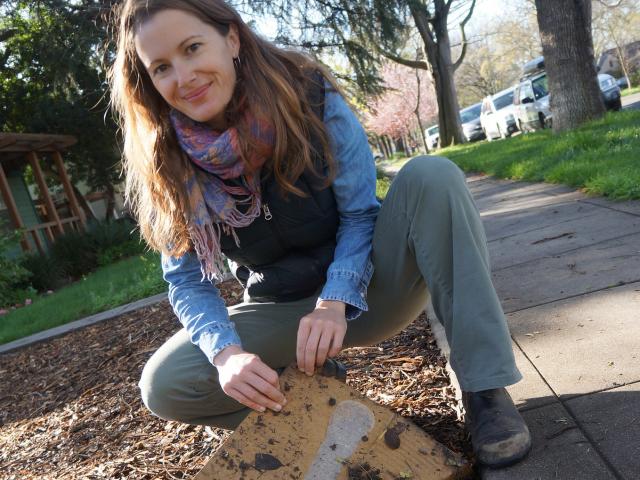
Students, volunteers and staff take a break after planting a large portion of the UC Davis Animal Science GATEway Garden. The bench featured in this photo was once a large animal "squeeze chute" which has been re-purposed by the Animal Science crew to serve as seating in this unique garden.
Have you seen the UC Davis Animal Science GATEway Garden? Be sure to stop by when you get a chance to check out the newly-planted beds and to enjoy the peaceful surroundings, that is, if the nearby donkey is not braying!
You may feel as though you are trespassing because there is a gate at the entrance, but it pushes right open to give visitors a closer glimpse of the animals, and, once the interpretive signage is installed, an educational look at the research being conducted here. Take note of the farm equipment re-purposed by creative Animal Science crew members; there’s a bench viewing area created using old wagon wheels, another seating area that makes a squeeze chute look inviting (see photo at the left), planters made from feeding troughs, and a picnic bench fashioned from a hay feeder.
Under the large valley oak at the center of the garden you will find a selection of California natives known to thrive in this tree’s shade. Large sandstone rocks brought in from the upper reaches of Putah Creek provide visual definition and serve to separate the planting areas within the raised beds. As the plants radiate out from the oak you’ll find a mix of selections native to the southwest and high-desert including a variety of grasses typically consumed by domesticated animals raised in these areas.
Notice the lack of landscaping west of the oak tree? That’s a placeholder for a large teaching deck yet to be installed.
READ MORE about the history of the creation of this garden here.
VIEW A SLIDESHOW OF PHOTOS
Arboretum Drive now open to bikes and pedestrians

The construction involved in the creation of the newest portion of Arboretum Drive is complete and almost of all of the landscaping installed on this pedestrian and bikeway-only path formerly known as Old Davis Road.
In order to ease car congestion near the core of campus, “new” Old Davis Road leads visitors from the UC Davis freeway exit all the way to the City of Davis while the new Arboretum Drive (formerly Old Davis Road) is reserved for bikes and pedestrians. Does none of this make sense to you? Read more about this project and the road changes here.

Photo caption: Some of the staff and volunteer gardeners responsible for installing the new landscape around the Arboretum Drive entry plaza.
One of the most exciting parts of this transformation was the creation of an Arboretum entry plaza near the campus’s front door, just past the Mondavi Center for the Performing Arts, in addition to an attractive brick walkway leading visitors into the Mary Wattis Brown Native Plant Garden. The plan is for plazas and pathways like this to appear throughout the Arboretum.
Narrowing the road and creating a thoroughfare for bikes and pedestrians opened up a significant area in need of landscaping. This portion of the project was managed by Stacey Parker, UC Davis Arboretum GATEways horticulturist. Her volunteers teamed up with other Arboretum volunteer gardening teams to create a landscape worthy of this high-profile entrance and transition seamlessly to nearby gardens.
This project also included a new entrance and exit from the UC Davis Arboretum’s T. Elliot Weier Redwood Grove and improved transitions from Arboretum pathways to the road. If you haven’t been to this area of campus in a while, it’s worth a trip just to enjoy a stroll along this new portion of Arboretum Drive without having to worry about car traffic.
CHECK OUT OUR SLIDESHOW of photos documenting the progress of this project.